

Today, we’re bringing you an important guest post from a go-to expert in the permitting space.
Ben Schifman is a Senior Technology Fellow at the Institute for Progress, where he focuses on emerging technology policy. His interests include the connection between AI policy and energy, infrastructure, and “physical world” regulatory frameworks.
Previously, Ben served as an Attorney-Adviser at the U.S. Department of the Interior’s Office of the Solicitor, where he advised on energy law and policy. Before that he worked as a Trial Attorney for the United States Department of Justice, Environment and Natural Resources Division where he litigated challenges to infrastructure projects and served as the Department’s National Environmental Policy Act (NEPA) coordinator.
In 2021, after investing tens of millions of dollars and a decade of development, Ormat Technologies received federal approval to build the Dixie Meadows Geothermal Project: a zero-emission, baseload power project located on Bureau of Land Management (BLM) land. Two days before Ormat planned to break ground, a federal judge halted the project; it remains unfinished to this day.
The lawsuit challenging the project alleged (among other things) that the environmental review under the National Environmental Policy Act (NEPA) was not sufficient. From the bench, the Judge was unusually candid about whether he thought the Plaintiffs were likely to prevail on this claim, stating: “I really can’t say as I sit here whether there is a strong likelihood of success on the merits.” He issued a preliminary injunction — stopping the project — regardless.
The Ninth Circuit ultimately stayed the injunction, and Ormat began construction. But the “litigation doom loop” — a cycle of agency review, litigation, judicial remedy, and then more review — had begun. Following the injunction, the Plaintiffs sought an emergency endangered species listing for the Dixie Valley toad in April 2022, which created an entirely new permitting obstacle. Ormat again halted construction, and then downsized the facility to 20% of its original capacity. In 2023 BLM began a supplemental NEPA review. As of late 2025, more than four years after BLM’s original approval, and a decade after Ormat’s permit application, the project remains unbuilt. Ormat is now suing the Fish and Wildlife Service over the toad’s listing, while BLM has attempted to fast-track the project under emergency permitting procedures — which have themselves drawn threats of new litigation.
A single preliminary injunction, issued by a judge who openly doubted the plaintiffs’ ultimate likelihood of success in their lawsuit, triggered a chain of events that may have effectively killed a zero-carbon energy project bringing much needed 24-7 baseload power to the grid — all before any court determined that BLM actually violated the law.
This is an example of the litigation doom loop. And because the SPEED Act, the most significant NEPA reform effort in decades, does not address preliminary injunctions, it doesn’t fully solve it — even in NEPA cases.
What the SPEED Act changes — and what it doesn’t
The SPEED Act’s most consequential provision concerns what happens when a court finds that an agency violated NEPA. As I describe in a longer piece, under current law courts have broad discretion when fashioning remedies for NEPA violations: they can leave the challenged permit in place while the agency corrects the NEPA error (remand); void the permit (vacatur); or issue a specific prohibition or direction (an injunction), to halt some or all of the permitted activity.1
The SPEED Act eliminates that discretion. Under the Act, “the only remedy the court may order . . . is to remand, without vacatur or injunction, the final agency action to the agency.” The agency gets 180 days to fix the problem, during which the project can continue. I have written about how this is not the only possible solution at the final remedies stage, and that it entails significant tradeoffs with NEPA’s goals of informed decision-making.
Regardless, this significant (and controversial) change does not address the full scope of the problem that litigation can pose to federal infrastructure projects. The SPEED Act applies exclusively to final judgments. But as the Dixie Meadows Project painfully demonstrated, projects can be halted by preliminary injunctions long before final judgment.
The blind spot: preliminary injunctions
A preliminary injunction is an emergency court order that is intended to preserve the status quo while litigation proceeds.2 In NEPA cases, plaintiffs often seek preliminary injunctions to stop work while a court decides whether the agency actually failed to conduct sufficient environmental review.
A party seeking a preliminary injunction must establish that: (1) it is likely to succeed on the merits, (2) it is likely to suffer irreparable harm in the absence of preliminary relief, (3) the balance of equities tips in its favor, and (4) an injunction is in the public interest.3
The Supreme Court has emphasized that preliminary injunctions are meant to be “extraordinary remedies never awarded as of right.”4 But they are not uncommon; courts retain significant discretion in applying them as indeed the decision in Dixie Meadows demonstrates. The project is just one of many delayed or defeated by litigation at this stage of the permitting process.
Judicial review, on SPEED
The SPEED Act has no provisions directly addressing preliminary injunctions. However, the Act could be thought to indirectly limit their effects through its strict litigation deadlines. SPEED requires plaintiffs to sue within 150 days; directs district courts to resolve NEPA claims within 180 days of the administrative record being lodged; and gives appellate courts another 180 days to hear any appeal. If courts actually followed these deadlines, a preliminary injunction that lasted through the resolution of the case on appeal would be in force for 16 months, as demonstrated in the table below.
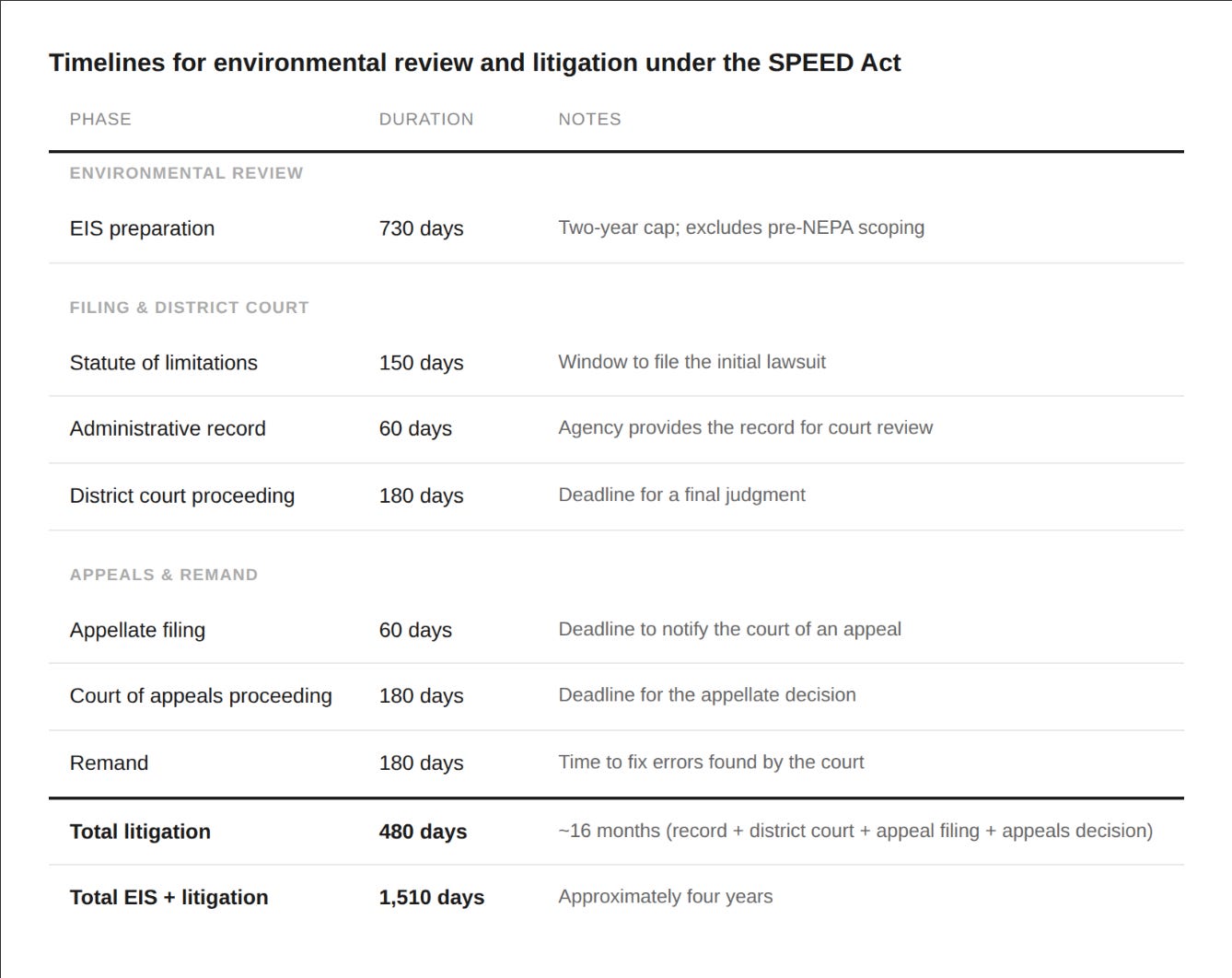
But will courts comply with these deadlines? History suggests they likely will not.
Congress has tried mandating judicial deadlines before. The Speedy Trial Act generally requires criminal trials to begin within 70 days of indictment — yet courts routinely grant continuances.5 The Antiterrorism and Effective Death Penalty Act (AEDPA) imposed timelines for habeas corpus decisions; courts regularly exceed them.6 The Supreme Court has characterized such statutory deadlines “directives” rather than rigid jurisdictional limits.7
Federal judges have existing dockets and competing priorities — including criminal cases where there is not only a statutory but also a constitutional right to a speedy trial. Judges also have limited resources. District court filings have grown by 30% since 1990 but judgeships increased by only 4% in that time. The number of civil cases pending more than three years has risen 346% in the last 20 years.
Under these circumstances, Congressional deadlines without accompanying resources for the judiciary are unlikely to make a difference. Federal judges have lifetime tenure and Congress has never impeached a federal judge over missed deadlines (indeed, only 15 judges have ever been impeached). Ultimately, nothing in the SPEED Act guarantees courts will adhere to its deadlines. And if they don’t, a preliminary injunction granted at the start of a lawsuit could last for months — or even years.8
Reasonable limits on preliminary injunctions
Preliminary injunctions are an important judicial remedy and a longstanding part of our legal system. Eliminating preliminary injunctive relief — as SPEED does for injunctive relief at the conclusion of a case — is unwise: injunctions are needed in extraordinary cases to prevent irreparable harm resulting from genuine legal errors.
However, Congress should adjust the traditional equitable factors to ensure that preliminary injunctions are brought and resolved quickly, and only in cases where plaintiffs have a strong showing of success on the merits. In the Dixie Meadows case the Judge was unusually candid, admitting that he “really [couldn’t] say” whether the plaintiffs were likely to succeed. But he enjoined the project anyway. Strengthening the traditional equitable injunction factors can ensure the preliminary injunctions serve their intended function — preventing truly irreparable harm during the pendency of a lawsuit in which a plaintiff is likely to ultimately prevail — while limiting those brought for the purpose of delay, disruption, or where the procedural error would not have changed the outcome.
Here are some complementary reforms Congress should consider, which I describe in more detail in a longer piece.
1. Prompt filing requirement
Preliminary injunctions are especially damaging when a plaintiff waits months or years after the challenged decision is made — often after construction has begun — for the purpose of maximizing disruption or leverage.
Existing case law generally recognizes that a plaintiff’s delay in seeking emergency relief undermines a claim of irreparable harm. For instance, in Quince Orchard Valley Citizens Association v. Hodel, the Fourth Circuit held that a plaintiff’s “unexcused delay” in seeking a preliminary injunction is strong evidence that the alleged harm is not actually “irreparable.”9 The logic is intuitive: if an injury is truly imminent and irreparable, a diligent plaintiff would not sit on their rights for months.
But because “promptness” is currently just one of many discretionary factors courts weigh, it hasn’t reliably deterred strategic delay. Congress should codify a rebuttable presumption that any motion for a preliminary injunction filed more than 30 days after the challenged final agency action carries a presumption that the harm is not irreparable. Plaintiffs could rebut this presumption by showing that their delay was not strategic but rather caused by inadequate public notice or significant new information that was not reasonably discoverable within the 30-day window.
This would turn a discretionary judicial factor into a clear legal deadline, motivating opponents to bring challenges forward immediately so they can be resolved more promptly and with less disruption.
2. Multiplicative merit standard
Under current law, to obtain a preliminary injunction, a plaintiff must show a “likelihood of success on the merits.” But courts often evaluate this factor by looking at the plaintiff’s strongest single argument — even when the plaintiff must clear several independent legal hurdles to ultimately prevail.10
The Fourth Circuit identified this problem in the 2025 decision American Federation of Teachers v. Bessent.11 Judge Richardson, writing for the majority, argued that when a plaintiff must prevail on several independent, dispositive issues — such as establishing standing, proving final agency action, and winning on the merits — the overall likelihood of success is not the probability of winning the strongest argument. It is the product of the probabilities of succeeding on every dispositive issue.
As the court illustrated, even if a plaintiff is a 3:1 favorite (meaning a 75% chance) on five distinct legal hurdles, the probability of running the table on all five is only about 24%. A plaintiff who is likely to win any single issue can still be a 3:1 underdog in the case overall.
Congress should codify this framework, requiring courts to determine the cumulative probability of success across all independent, dispositive issues and issue written findings specifying the estimated probability assigned to each. This ensures that preliminary injunctions — “extraordinary remedies never awarded as of right” — are reserved for cases where the plaintiff is truly likely to prevail on the merits of the case, not just on a single high-profile merits issue the court may never reach.
3. Prejudicial error standard for preliminary injunctions
Under current law, plaintiffs can obtain injunctions to halt work based on procedural errors that likely wouldn’t change the outcome. If an environmental assessment omitted discussion of an issue but the agency would have reached the same decision anyway, what purpose is served by a preliminary injunction halting the project?
Congress should require plaintiffs seeking preliminary injunctions in NEPA cases to demonstrate not just a likelihood of success in showing a NEPA violation, but a likelihood of success in showing the violation was prejudicial — meaning there’s a reasonable possibility the error affected the agency’s substantive decision.
Requiring plaintiffs to show prejudice is consistent with the Administrative Procedure Act and with recent dicta from the Supreme Court in the recent Seven County Infrastructure Coalition case that I have written about here.12 This reform would preserve preliminary relief for cases where the NEPA violation genuinely calls the agency’s decision into question.
Reforming preliminary injunctions in NEPA cases isn’t enough
The reforms proposed above would help prevent issuance of preliminary injunctions that are brought in cases where a plaintiff is unlikely to prevail or where irreparable harm is not likely. But reforming preliminary injunction standards in NEPA cases alone is not sufficient to break the “doom loop” that limits America’s ability to build infrastructure. Most major infrastructure projects that are subject to litigation are challenged under multiple statutes simultaneously: NEPA alongside the Endangered Species Act, the Clean Water Act, the National Historic Preservation Act, and others. The Dixie Meadows lawsuit — which involved numerous claims aside from those brought under NEPA — illustrates this dynamic.
NEPA-specific reforms like the SPEED Act cannot reach injunctions grounded in other federal statutes, and real-world litigation rarely presents pure NEPA claims. Still, NEPA is among the most frequently litigated permitting statutes, and it is the claim most commonly deployed for strategic delay precisely because its procedural nature makes violations easy to allege and difficult to disprove quickly. Reforming preliminary injunctive relief in NEPA cases would narrow the attack surface available to litigants pursuing delay, and provide a blueprint for similar reforms to remedies available through other laws.
While permitting reform efforts like the SPEED Act are wise to focus on final judgments, they should not be blind to preliminary remedies. Imposing reasonable limits at each stage can ensure that NEPA litigation serves its intended purpose — allowing agencies and the public to be informed about the environmental impacts of federal decisions — rather than functioning as a mechanism to delay the infrastructure our country needs to meet the challenges of the coming century.
Ben Schifman is a Senior Fellow at the Institute for Progress, where he focuses on energy, infrastructure, and AI policy. He previously served as an attorney at the Department of the Interior and the Department of Justice.
Vacatur often, though not always, results in a project ceasing construction. If a permit authorizing construction is vacated, the permitted construction must cease. But large-scale infrastructure projects often involve “non-federal” segments that do not require federal permits to proceed. And for segments already constructed, the loss of a permit renders that infrastructure “unauthorized” but does not necessarily require automatic removal. See Standing Rock Sioux Tribe v. U.S. Army Corps of Engineers, 985 F.3d 1032 (D.C. Cir. 2021) (vacatur of permit rendered pipeline an unauthorized encroachment on federal land and Army Corps had discretion whether or not to seek a trespass action).
University of Tex. v. Camenisch, 451 U. S. 390, 395 (1981).
Winter v. Natural Resources Defense Council, Inc., 555 U.S. 7 (2008).
Id.; Starbucks Corp. v. McKinney, 602 U.S. 339 (2024).
See, e.g., Zedner v. United States, 547 U.S. 489 (2006).
See Orona v. United States, 826 F.3d 1196, 1198-1199 (9th Cir. 2016) (per curiam); In re Siggers, 132 F.3d 333, 336 (6th Cir. 1997)
See Dolan v. United States, 560 U.S. 605 (2010); United States v. Montalvo-Murillo, 495 U.S. 711 (1990).
The median time from filing to disposition of a civil case in 2025 was seven months, but in some districts it is up to several years.
Quince Orchard Valley Citizens Association, Inc. v. Hodel, 872 F.2d 75 (4th Cir. 1989).
A plaintiff seeking to challenge an agency’s environmental review under NEPA must clear several distinct jurisdictional and threshold hurdles before a court will even reach the merits of the NEPA claim. First, the plaintiff must establish Article III standing by proving an injury in fact, causation, and redressability. See Lujan v. Defs. of Wildlife, 504 U.S. 555, 560–61 (1992). The claim can’t be moot. Already, LLC v. Nike, Inc., 568 U.S. 85, 91 (2013). They must demonstrate subject-matter jurisdiction, typically invoking federal question jurisdiction. See 28 U.S.C. § 1331. Because the suit must proceed under the Administrative Procedure Act, the plaintiff must establish that the challenged conduct constitutes a “final agency action.” 5 U.S.C. § 704; see Lujan v. Nat’l Wildlife Fed’n, 497 U.S. 871, 882 (1990). They must have brought their claim within the limitations period, 28 U.S.C. § 2401(a). The plaintiff must show that their grievance arguably falls within the “zone of interests” protected by NEPA. See Match-E-Be-Nash-She-Wish Band of Pottawatomi Indians v. Patchak, 567 U.S. 209, 224 (2012). A plaintiff must also have participated in the agency’s decision-making process. Dep’t of Transp. v. Pub. Citizen, 541 U.S. 752, 764–65 (2004). Plaintiffs must overcome each of these legal hurdles to ultimately prevail on the merits of their lawsuit.
Am. Fed’n of Teachers v. Bessent, No. 25-1282 (4th Cir. 2025).
Seven Cnty. Infrastructure Coal. v. Eagle Cnty., 145 S. Ct. 1497 (2025).
Extraordinary analysis of a pervasive problem. Excellent work!